
Adding Capacity: What the Second Unit Really Buys
The first machine answers a question about whether mining works for you at all. The second answers a different one about scale, and the arithmetic is less flattering than the sales material suggests. A single 250 TH/s unit reaches 0.05 BTC in 445.8 days; a pair running the same target finishes in 222.9 days. You have doubled the capital and halved the wait, which is progress, but it is not the doubling of income that the word "expansion" implies.
Key takeaways
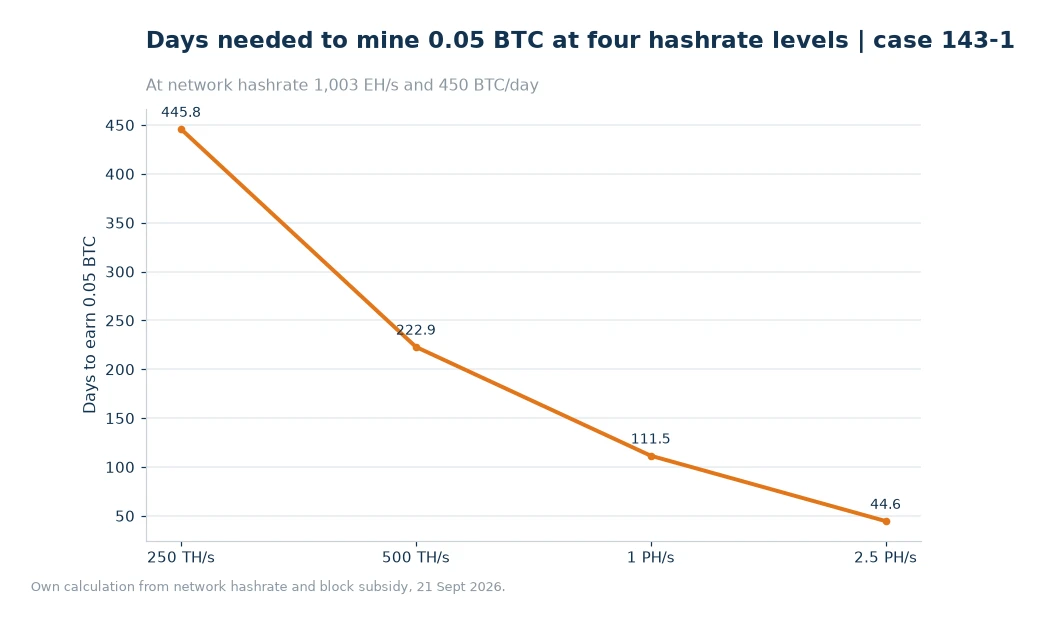
- 0.05 BTC takes 445.8 days at 250 TH/s, 222.9 at 500 TH/s, 111.5 at 1 PH/s and 44.6 at 2.5 PH/s.
- Ten units of 250 TH/s reach the target in roughly a tenth of the time a single unit needs.
- Pool Hashrate determines whether your added capacity actually increases your share of settlements.
- Pool Luck is worth reading before an expansion decision, because a lucky streak is not a reason to buy more hardware.
What the first unit proved, and what it did not
One machine on a shelf proves that the power circuit holds, that the noise is tolerable, that the network link is stable and that the pool account credits correctly. Those are real questions and one unit answers them at the lowest cost. Nothing about a single machine tells you whether the site can support ten, because cooling, cabling, breaker capacity and floor loading all change at a different scale from the one you tested.
So the second unit is best treated as a capacity test rather than a repeat purchase. Before it arrives, measure the room temperature at the exhaust of the first machine, not at the far wall. Check the current draw on the circuit with everything else running. Confirm the network switch has spare ports and that the uplink is not already saturating. Each of those measurements is cheap and each one prevents the classic expansion failure where the second unit works but the first one starts overheating.
Halving a calendar is not doubling income
Doubling hashrate doubles the daily credit, because the credit is proportional to shares submitted. That part is straightforward: 500 TH/s earns 0.00022430 BTC a day where 250 TH/s earns 0.00011215. What does not double is the target, because the target is the thing you chose and it stays fixed. The visible change is the date, which halves from 445.8 days to 222.9. The Profit Calculator will show the same pair of figures in dollars at the current price, which is useful when the expansion case goes to somebody who thinks in currency rather than coin.
That distinction matters when the expansion is financed. If the second unit is bought with cash you already hold, the halved calendar is a genuine improvement in how quickly you reach the target. If it is bought with debt, the repayments arrive monthly while the credits arrive hourly, and the calendar does not tell you whether the cash flow covers the schedule. Two different questions, one of which the chart cannot answer.
The share you already have
Your slice of a settlement is your hashrate divided by the pool's total, which is why the Pool Hashrate figure deserves attention before you commit. If the pool is growing at the same rate as your fleet, added capacity buys no additional share and the calendar improvement is diluted. If the pool is flat while you add machines, the added capacity converts almost fully into credits.
Pool Luck is the other reading, and it is the one that most often gets misused. A run of blocks found above expectation makes the last month look strong, and that strength is exactly when expansion feels most justified. Under PPS+ the hourly credit does not depend on luck at all, so a lucky month is not evidence about your future credits. Read the reading, note it, and decide on the hashrate arithmetic rather than on the recent mood of the block count. Both figures sit on the ViaBTC BTC Mining Pool state page next to difficulty and network hashrate.
Where the extra machine does not help
Three constraints bind before the pool does. The first is electrical: a circuit rated for one unit will not carry three, and the cost of an upgrade can exceed the cost of the hardware. The second is thermal: two machines in a small room heat it faster than a linear estimate suggests, and the second unit's fans will run harder than the first's. The third is attention: each machine needs monitoring, firmware updates and occasional physical intervention, and the marginal attention per unit falls only if you have a system rather than a habit.
The honest test is to run the site at its current maximum for a fortnight before ordering. If the existing unit shows any instability under normal summer conditions, adding another will not create stability, it will share the instability. Mining rewards boring operations, and the least interesting site is usually the one that lasts.
| Units at 250 TH/s | Total hashrate | BTC per day | Days to 0.05 BTC |
|---|---|---|---|
| 1 | 250 TH/s | 0.00011215 | 445.8 |
| 2 | 500 TH/s | 0.00022430 | 222.9 |
| 4 | 1 PH/s | 0.00044861 | 111.5 |
| 10 | 2.5 PH/s | 0.00112152 | 44.6 |
The table is deliberately built from identical units so the progression is clean. Real fleets are mixed, and a mixed fleet should be summed in terahashes before the calendar is read. A site with one 500 TH/s unit and two 250 TH/s units behaves like the 1 PH/s row, not like three separate purchases.
Worked example
Follow the two-unit case from the chain data.
- Per TH/s per day: 450 ÷ 1,003,000,000 = 0.00000044865 BTC.
- One unit of 250 TH/s: 250 × 0.00000044865 = 0.00011215 BTC a day.
- Two units: 0.00011215 × 2 = 0.00022430 BTC a day.
- Days for 0.05 BTC: 0.05 ÷ 0.00022430 = 222.9, exactly half the single-unit figure.
- Value of the target: 0.05 × 84,692 = $4,234.60, unchanged by the expansion.
- Add two more units to reach 1 PH/s: 0.00044861 a day, and 0.05 ÷ 0.00044861 = 111.5 days.
- Ten units: 0.00112152 a day and 44.6 days, so the calendar compresses by the same factor as the fleet.
Now attach cost. If each unit draws the same power, the electricity bill scales with the fleet while the calendar shrinks, so the cost per BTC is roughly constant across the rows. Expansion changes the timing of the target, not the efficiency of reaching it, unless the new units are more efficient than the old ones.
Frequently asked questions
Does a second machine double my BTC per day?
Yes, if it matches the first. Two 250 TH/s units produce 0.00022430 BTC a day against 0.00011215 for one, so the target of 0.05 BTC arrives in 222.9 days instead of 445.8.
How many units reach 0.05 BTC in under two months?
Ten units at 250 TH/s, or 2.5 PH/s in total, take 44.6 days.
Should I expand after a strong month?
Not on that basis alone. Under PPS+ a strong month from Pool Luck does not change future hourly credits, so decide on hashrate, power capacity and the calendar.
Write the fleet total before the order
Expansion decisions go wrong when they are made per unit. Convert the proposed purchase into total fleet hashrate first, then read the calendar at that total, then check the site constraints against it. A plan that reads "one more machine" hides the electrical and thermal work; a plan that reads "500 TH/s, 222.9 days to 0.05 BTC, needs a 32 A circuit and 4 kW of cooling headroom" is a plan somebody can actually execute.
Keep the old unit in the sum even after it is paid off. It still draws power, still occupies a slot and still counts toward the fleet total, and leaving it out is how operators convince themselves that a replacement is cheaper than it is. The Statistics page gives the network context for the next recalculation, and a simple note of the date, the fleet total and the days-to-target is enough of a record to compare one quarter with the next.
Sources: ViaBTC pool state and statistics pages for network inputs, and the fee page for the listed 4% on the PPS-settled block reward[1]. Table values rest on a 21 Sept 2026 reading of 132.76 T difficulty, one zettahash of network hashrate, 3.125 BTC per block, 144 blocks daily and BTC at $84,692. All figures here were read 21 Sept 2026, with publication on 24 Oct 2026.